I know you should be blogging. You've read the stats. You've seen competitors ranking for keywords you want. You've probably started a blog three times already.
And then it takes you six hours to write one post.
By hour four, you're tweaking fonts in Canva instead of shipping features. By hour five, you're questioning if any of this matters. By hour six, you publish something you're not even proud of—and swear you'll get to the next one "soon."
That "soon" turns into three months. Your blog dies. Again.
Here's the thing: Orbit Media's annual survey found that the average blog post takes about four hours to write. But that's the average. For founders writing technical SaaS content? It's often double that.
You don't have ten hours per post. You have a product to build.
So let's talk about how to cut that time in half. Or—if you're honest about your priorities—when to stop doing it yourself entirely.
Why It Takes So Long (And Why You Keep Failing)
Before we fix the problem, let's figure out what's actually eating your time.
You fall down research rabbit holes
You sit down to write about "how to reduce churn" and suddenly you're 47 tabs deep reading academic papers about customer behavior. Three hours later, you haven't written a single sentence.
Sound familiar?
Founders are naturally curious. That's what makes you good at building products. But that same curiosity kills your writing speed. You want to cover everything, cite every source, address every objection.
You don't need to know everything to write a useful post. You need to know enough.
Perfectionism is murdering your output
Here's something I hear constantly from founders: "I don't want to put out anything mediocre."
Noble goal. Terrible strategy.
That perfectionism means you spend two hours on your intro alone. You rewrite the same paragraph six times. You refuse to hit publish until it's "right."
Meanwhile, your competitor posted three okay-ish articles this month and is ranking for keywords you're still "researching."
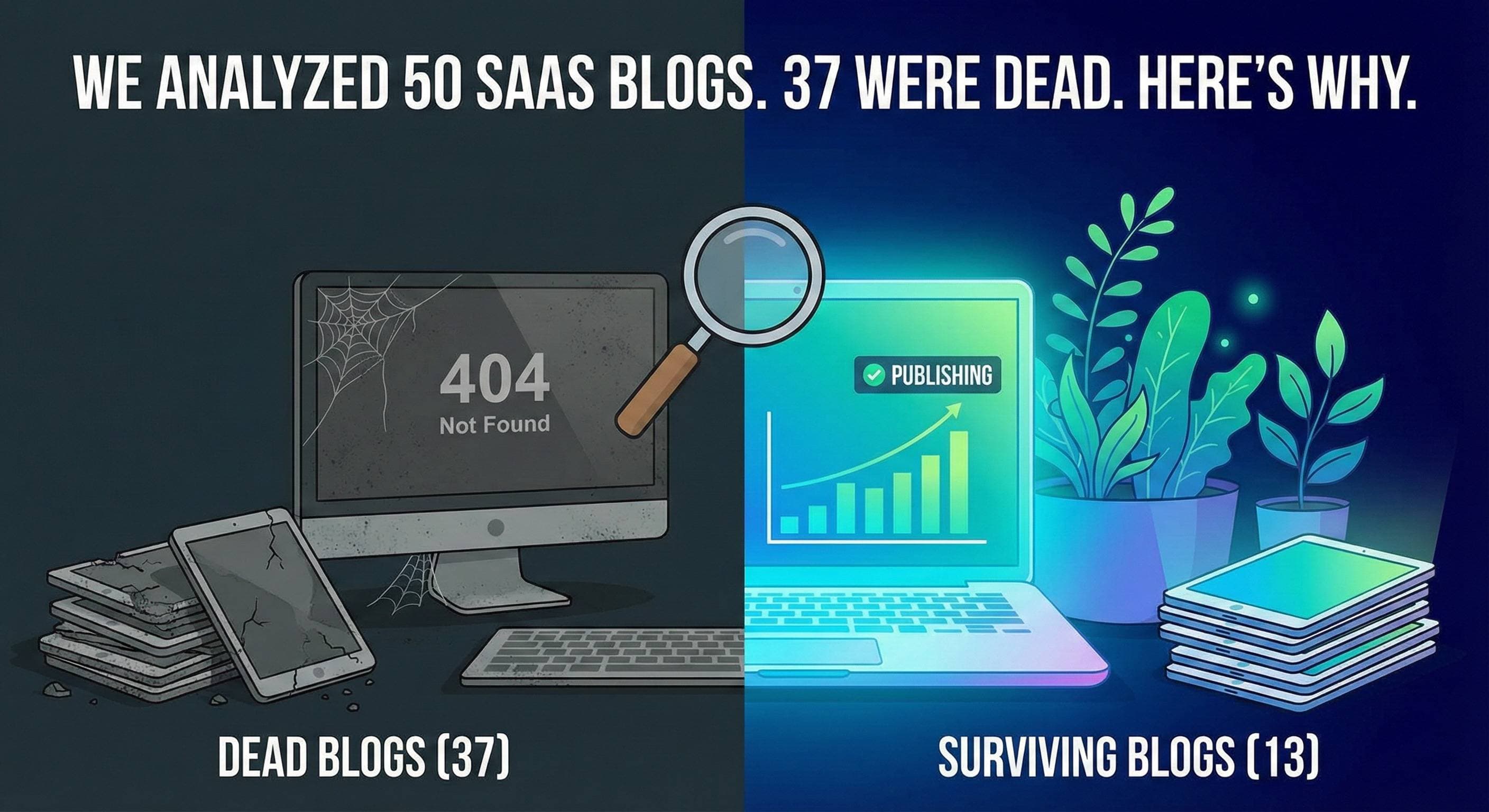
We analyzed 50 SaaS blogs and found that 17% died from exactly this—what we called "The Perfectionist" pattern. Three beautiful articles over two years, then nothing. The founder burned out trying to make every piece perfect.
SEO optimization feels like homework
Title tags. Meta descriptions. Keyword density. Internal links. Schema markup. Featured snippet optimization.
The list goes on. And if you're not a marketer, it all feels like busy work that has nothing to do with actually helping your readers.
So you either skip it entirely (and wonder why nobody finds your posts) or spend an extra hour cramming keywords into sentences that already sounded fine.
You have no process
This is the real killer.
Every time you write, you start from scratch. Where do I find topics? How do I outline? What makes a good intro? When do I add images?
Without a system, every blog post is a creative struggle. And creative struggles take forever.
The 2-Hour Blog Post Framework
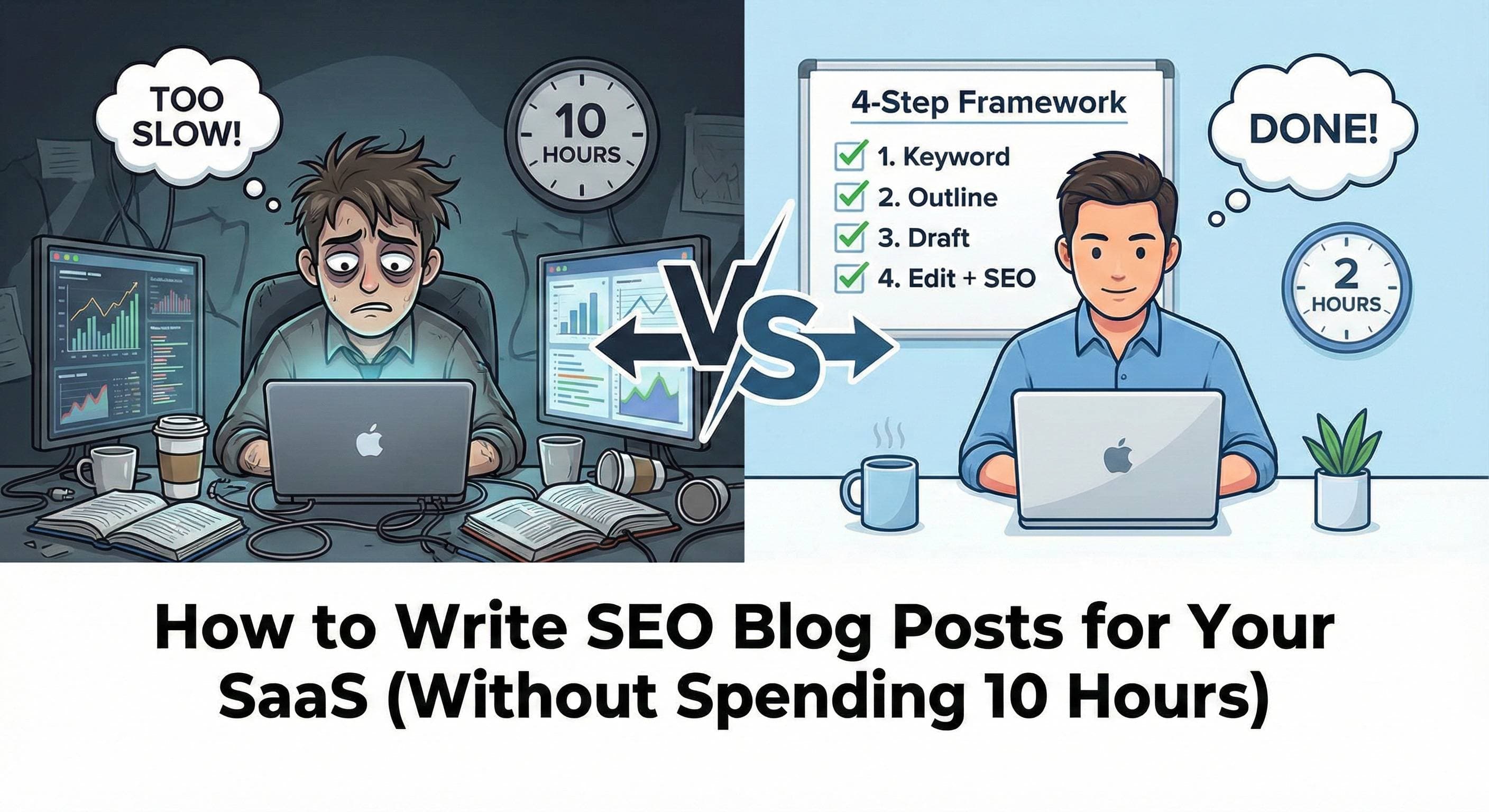
Here's how to actually get posts done. Not "perfect" posts. Working posts that rank, help readers, and don't consume your entire week.
| Step | Time | What You're Doing |
|---|---|---|
| Keyword research | 15 min | Find one long-tail keyword you can realistically rank for |
| Outline | 15 min | Build H2s from "People Also Ask" questions |
| Draft | 60 min | Write an ugly first draft without editing |
| Edit + SEO | 30 min | Clean up, add keywords, write meta description |
Let's break each one down.
Step 1: Find One Winnable Keyword (15 minutes)
Notice I said "one." Not a cluster. Not a content pillar. One keyword.
Stop chasing head terms like "CRM software" or "project management tool." You're not going to outrank HubSpot. Not with a domain authority of 15 and three blog posts.
Instead, go long-tail. Think:
- "CRM for real estate agents"
- "project management for agencies under 10 people"
- "how to track customer support tickets in spreadsheets"
Lower volume? Yes. Actually rankable? Also yes.
Here's the quick process:
- Open a free tool like Ubersuggest or look at Google's autocomplete
- Type something related to a problem your product solves
- Find a specific question or phrase with some search volume (even 100/month is fine)
- Check the first page results—if it's all giant companies with 5,000-word guides, pick something else
Fifteen minutes. One keyword. Move on.
Step 2: Build Your Outline from PAA (15 minutes)
Google literally tells you what people want to know. It's called "People Also Ask."
Search your keyword. Look at the PAA box. Those questions? They're your H2 headers.
If someone searches "how to reduce customer churn" and Google shows:
- What causes customer churn?
- How do you calculate churn rate?
- What's a good churn rate for SaaS?
Then your outline is:
- What causes customer churn (and what you can actually control)
- How to calculate churn rate the right way
- What's a realistic churn benchmark for your stage
This does two things. First, you're answering questions real people ask. Second, you might show up in those PAA boxes—which puts you above the fold without needing to rank #1.
Fifteen minutes. Outline done. Keep moving.
Step 3: Write the Ugly First Draft (60 minutes)
Here's where most founders mess up: they try to write and edit at the same time.
Don't.
Set a timer for 60 minutes and just write. Don't fix typos. Don't reword awkward sentences. Don't look anything up. If you need a stat, write "[ADD STAT HERE]" and keep going.
One trick that works surprisingly well: talk instead of type. Open a voice memo or use speech-to-text. You probably explain your product to customers all the time. That explanation? It's your first draft.
Most founders can speak 3,000 words in 30 minutes without trying. Typing that same content takes three hours.
The goal isn't quality. The goal is getting words on the page. You'll fix them later.
Step 4: Edit and Add SEO Basics (30 minutes)
Now you clean it up.
First pass (15 minutes): Read through once. Fix the obvious stuff—typos, sentences that don't make sense, paragraphs that go nowhere. Cut anything that doesn't earn its spot.
Second pass (15 minutes): Add the SEO basics:
- Put your keyword in the title, first paragraph, and one H2
- Write a meta description (155 characters, include the keyword)
- Add 2-3 internal links to other pages on your site
- Include one relevant external link to a credible source
- Add alt text to any images
That's it. You don't need to obsess over keyword density. Google's smarter than that now. Write something helpful and hit the basics.
Two hours. Post done.
What Actually Moves the Needle
Writing faster is only useful if you're writing the right things. Here's what actually matters for SaaS blogs—based on research, not vibes.
Long-tail keywords beat head terms every time
A meta-analysis of SEO effectiveness found an effect size of 1.049 (classified as "very strong") for well-targeted optimization. But that optimization works best when you're not competing against giants.
Think about it: would you rather rank #47 for "email marketing" or #3 for "email marketing for Shopify stores"?
The second one. Obviously. And the person searching that specific phrase is probably closer to buying anyway.
Consistency beats perfection
The blogs we studied that survived published about 4.4 posts per month on average. The ones that died? 0.3 posts per month.
That's not a quality gap. That's a showing-up gap.
One decent post every week beats one masterpiece every quarter. Organic search compounds over time—but only if there's something to compound.
Your product should show up (without being annoying)
Here's something weird: successful blogs actually mention their product more often than failing ones.
But they do it differently.
They show the product solving a real problem—a screenshot inside a tutorial, a feature demonstrated within a workflow. The article still helps even if you never sign up. But if you are looking for a solution, the product's right there.
Failed blogs either hide their product completely (and never convert anyone) or make every post a sales pitch (and nobody finishes reading).
Internal links matter more than you think
Successful blogs average about 6 internal links per 1,000 words. Struggling ones? Less than 1.
Every post should link to other posts. Every post should link back to your product where it makes sense. This helps SEO and it helps readers find more of your stuff.
When to Stop DIY-ing Your Blog
Look, I just gave you a framework to write posts in two hours. But I also need to be honest with you.
Some founders shouldn't be writing their own blog posts at all.
Signs it's time to outsource
Your blog keeps dying after 3-4 posts. If this is your fourth attempt at consistent blogging, the problem isn't your framework. It's that blogging isn't your thing—and that's okay.
Posts still take 6+ hours even with a system. Some people just write slowly. No shame in it. But your time might be worth more elsewhere.
You dread it every single week. If writing feels like a chore you're constantly avoiding, you'll eventually stop. Might as well plan for that.
You'd rather spend those hours on product. This is the most valid reason. If two hours of product work is more valuable than two hours of content, do the math.
The worst outcome isn't outsourcing. The worst outcome is starting another blog that dies in three months. We found that 37% of failed SaaS blogs followed that exact pattern.
A Different Way
This is why ShipContent exists.
We kept meeting founders who understood content mattered but couldn't keep it going. The blog would launch strong, get four posts, then go quiet when a feature deadline hit or a funding round started.
It wasn't that they didn't care. They just had too many other things demanding those hours.
We handle the research, writing, and SEO—but we work with founders so the content actually sounds like them and shows their product naturally. No generic listicles. No AI-generated fluff that tanks your rankings.
You stay involved where it matters (your expertise, your product, your perspective) without burning ten hours per post.
If you're tired of watching your blog die every few months, let's talk.
This post uses data from Orbit Media's 2024 blogging survey, a meta-analysis of SEO effectiveness (COSTING Journal, 2024), and our own analysis of 50 SaaS blogs. Framework adapted from research on founder content constraints.