Content outsourcing for SaaS is the process of delegating the research, creation, and optimization of blog posts and marketing copy to external professionals or specialized software tools. It is the primary mechanism through which founders scale organic growth without sacrificing the time needed to ship actual features. But let’s be honest—when was the last time you actually updated your blog? Research from Omnius (2026) indicates that organic search drives approximately 53% of all SaaS traffic, yet most solo founders are trapped in a cycle of production that leads to total burnout.
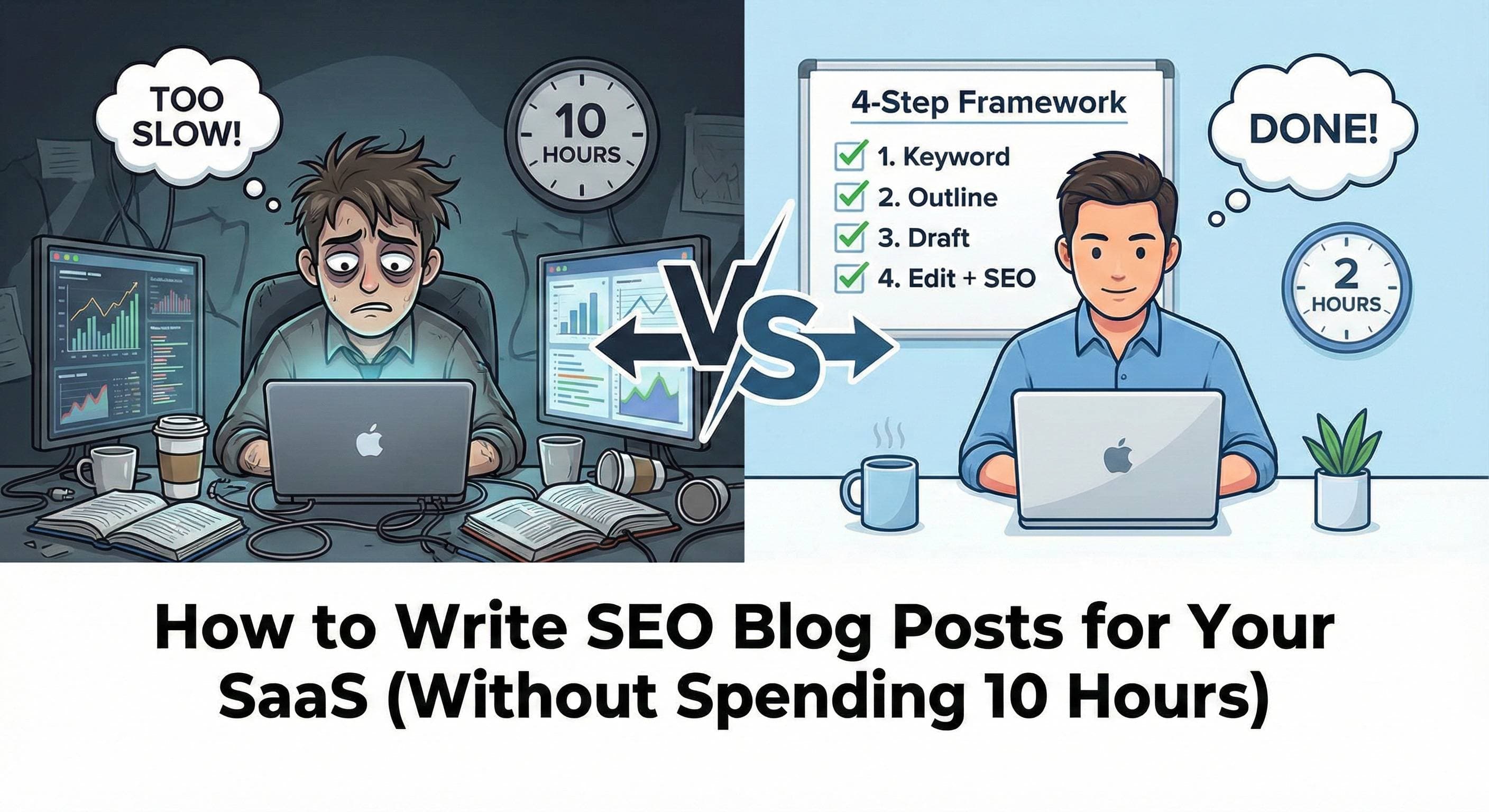
You know you need to publish. You know that 68% of SaaS organic traffic is driven by specific, long-tail keywords (Omnius, 2026). But you’re likely staring at a blank screen or a terminal, wondering how to turn that feature update into a story that resonates. This is the founder’s dilemma: spend ten hours writing one post or let the blog sit as a digital ghost town. In 2026, the choice isn't just between a human and a bot—it's about understanding the unit economics of your time.
The High Cost of Traditional Freelance Writers
Hiring a content writer sounds simple until you actually try to find one who understands what ARR, churn, or an API endpoint is. The market is frustratingly stratified. At the lower end, you have "content mills" or generalist platforms where you can find writers for $15–$40 per hour (Upwork, 2026). On the surface, it’s a bargain.
But there’s a hidden management tax. If you spend four hours fixing a $50 article because the writer didn't understand your product, you haven't saved money. You've just become an unpaid editor. If your time as a founder is worth $100 per hour, that "cheap" post actually cost you $450 in lost productivity. And that’s if it even ranks. According to research from RevenueZen (2026), while 96% of tech marketers have a content strategy, only 29% actually find it effective. Most of that waste comes from hiring generalists who produce superficial fluff that fails to build trust.
Then there are the subject matter experts (SMEs). These are the pros who charge $300 to $800 per post. They’re great—they require minimal hand-holding and can actually handle a technical deep dive. But for a bootstrapped founder, spending $3,200 a month on four blog posts is a heavy lift. It’s often the right choice for high-stakes white papers, but it’s hard to sustain for weekly organic growth.
And if you decide to write it yourself, the cost is even higher. We calculated the exact math in The $19/mo Growth Engine: Calculating the Opportunity Cost of Founder Marketing.
AI Writing Tools: Speed vs. Quality Trade-offs
By now, we’ve all tried dumping a prompt into ChatGPT or Claude. The allure is obvious: near-zero marginal cost and instant output. In fact, Siege Media (2026) reports that 90.1% of marketers are now using AI tools in their workflows. If you’re not using it, you’re likely falling behind in terms of sheer volume.
However, the risks are significant. AI is a probabilistic engine, not a truth engine. As Ryan Law, former VP of Content at Animalz, notes: AI content is often "peppered with falsehood and fiction: made-up quotes attributed to real people, data that doesn't exist, seemingly sensical ideas that fall apart upon closer inspection." For a SaaS company, a single hallucinated code snippet or a wrong technical fact can destroy your credibility in seconds.
There is also the "mediocrity trap." Because LLMs are trained on the average of the internet, their default output tends to be... average. In a world where everyone is using the same prompts, your blog starts sounding exactly like your competitor’s. You lose that "founder voice" that makes a startup human. Google’s 2024 and 2025 updates have made it clear: they prioritize E-E-A-T (Experience, Expertise, Authoritativeness, Trustworthiness). AI, by its very nature, lacks "Experience." It hasn't stayed up at 3:00 AM debugging a server outage. It hasn't felt the sting of a major churn event. Without that human element, your content is just digital noise.
The Hybrid Model: AI-Powered Editorial Services
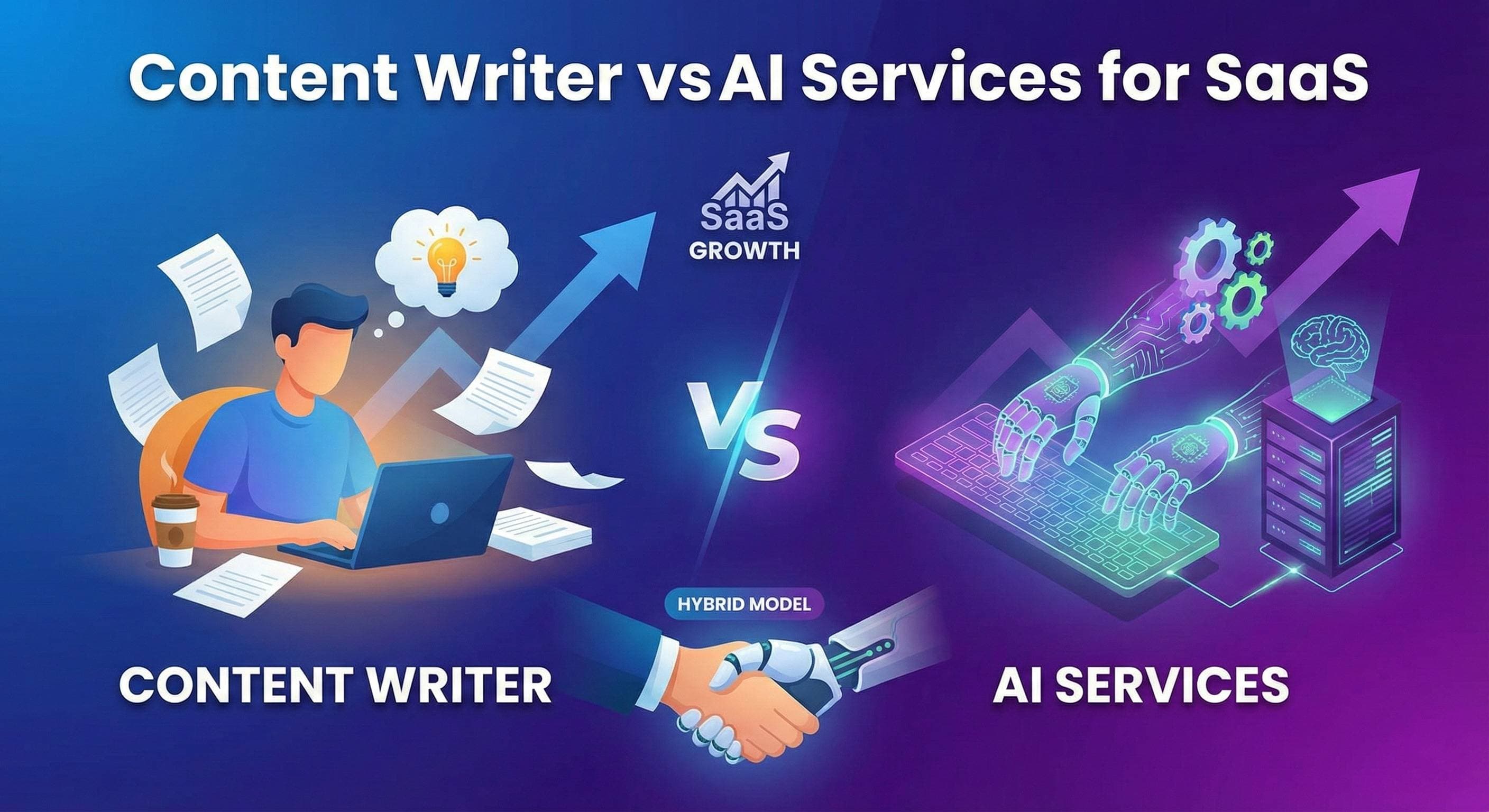
This is where the "Centaur" model comes in—a hybrid approach that uses AI for the heavy lifting but keeps a human in the driver’s seat. The most effective solo founders in 2026 aren’t writing everything from scratch, nor are they hitting "publish" on raw AI drafts. They use a structured, multi-agent workflow.
- AI Research & Outlining: Use agents to scrape competitor sitemaps and identify keyword gaps. To see how we automate this without losing quality, check out our methodology on Product-Aware AI vs. Generic LLMs. It explains how to scrape "Product DNA" instead of using generic prompts.
- Product Awareness: Feed the system your actual documentation, landing pages, and even recorded Loom demos.
- Human Drafting/Editing: A human (or a very sophisticated "product-aware" service) takes that raw data and adds the nuance, stories, and technical accuracy that LLMs miss.
This is exactly what we built ShipContent to solve. Most AI tools just guess what your product does. We scrape your site and research your specific market to deliver posts that actually sound like you. It’s about being "product-aware." If you’d rather not spend your weekends playing prompt engineer, you can put your growth on autopilot without the usual AI-isms.
According to RevenueZen, SaaS firms that use specialized agency or editorial support see 2.3x faster organic traffic growth compared to those doing it all in-house. That growth isn't just about more visitors—it's about the right visitors. People who see your content as a proxy for your software's quality. 55% of B2B buyers say that thought leadership is a major factor in their purchasing decisions (RevenueZen, 2026). If your content is generic, they’ll assume your product is too.
Comparing Your Production Options
| Metric | Founder-Led (DIY) | Raw AI (Bot) | Traditional Freelancer | ShipContent (Hybrid) |
|---|---|---|---|---|
| Time Cost | 10+ hours/post | 10 mins (bad) | 2-3 hours (mgmt) | 15 mins (review) |
| Financial Cost | $0 (High Opp. Cost) | $20/mo | $300-$800/post | Moderate Subscription |
| Technical Depth | Perfect | Dangerous/Low | Variable | High (Product-Aware) |
| SEO/GEO Rank | High | Low/Risk | Moderate | High |
| Authenticity | 100% | 0% | 70% | 90%+ |
How to Choose the Right Solution for Your Startup
Choosing how to outsource blog content depends entirely on your stage of growth and your technical complexity. If you are in a highly regulated industry—like Fintech or MedTech—you cannot afford a single AI mistake. You likely need a high-end SME or a founder-led approach for your core pillars.
However, if you're looking to capture the long tail and build a massive library of educational content, a hybrid service is the only way to scale without losing your mind. The "Content Hamster Wheel" is real, and it breaks founders every day.
Key Takeaways for Outsourcing:
- Audit your time: If you’re worth $100/hr, DIY is your most expensive option.
- Prioritize E-E-A-T: Make sure whoever (or whatever) writes for you has access to your product knowledge.
- Focus on the Long Tail: Don't compete for "Project Management." Compete for "How to sync Jira with X for remote teams."
- Distribute Forever: One blog post should become ten tweets, three LinkedIn posts, and a newsletter snippet.
As Ross Simmonds, founder of Foundation Marketing, famously says: "Content distribution is the secret sauce. Create once, distribute forever." But you can't distribute what you haven't shipped. You ship features. We ship content.
Stop letting your blog collect dust. Whether you hire a high-end ghostwriter or use a product-aware service like ShipContent, the goal is the same: building a compounding asset that works while you sleep. The trust you build today through high-quality, research-backed content is the revenue you’ll see six months from now. Don't let the AI noise distract you from the fundamental goal—helping your users solve problems.