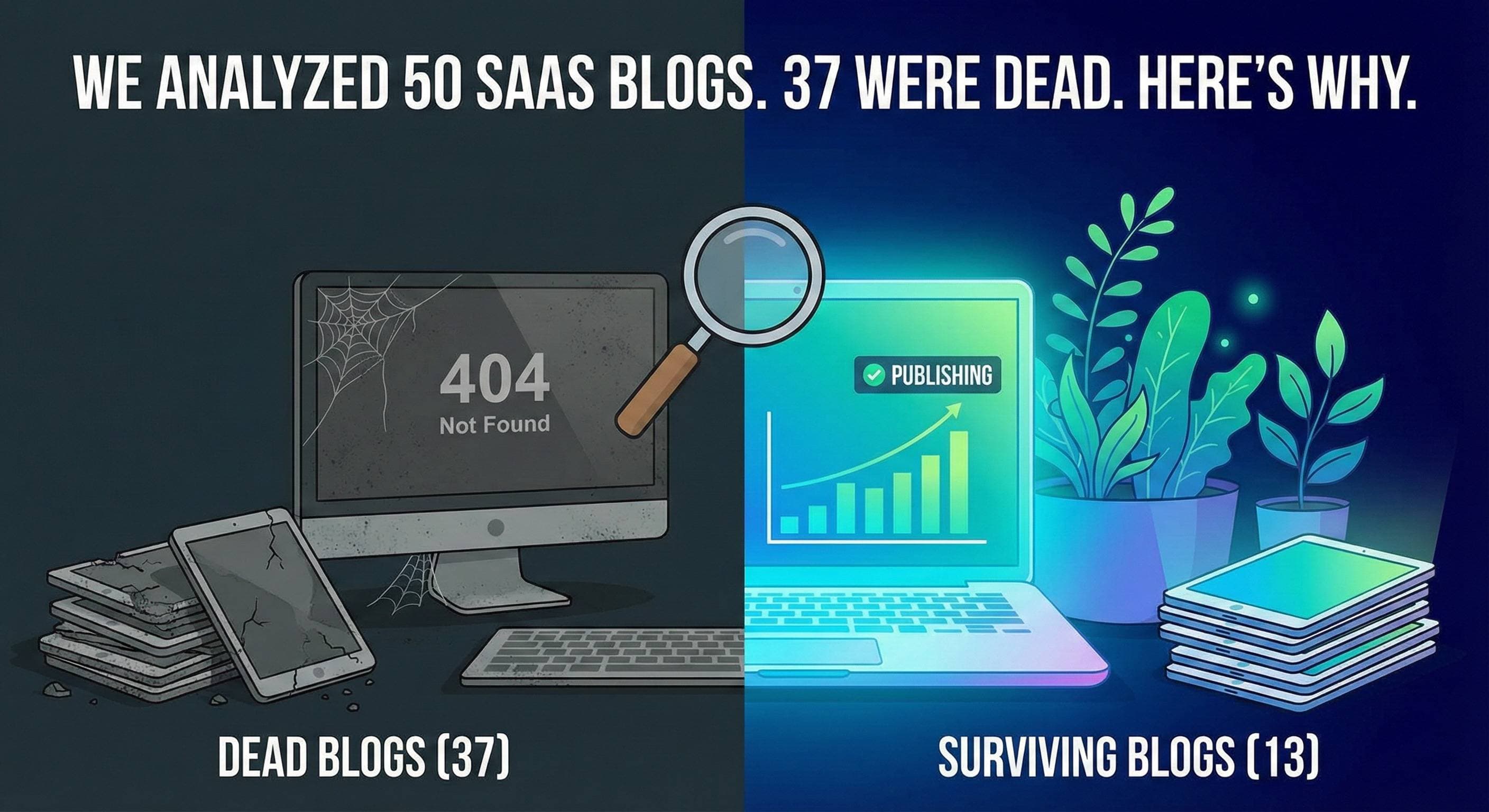
We spent last week going through 50 SaaS company blogs. Took longer than expected. What we found was pretty discouraging.
37 of them were dead. Nothing posted in six months or more. A few hadn't been touched in over a year.
These weren't tiny startups either. Some had raised millions. Customers were paying them real money. Nice designs. Content strategies that looked solid from the outside.
Then you'd click on the blog. Ghost town. Last post dated eight months ago. Maybe a lonely "We're excited to announce..." that never got a follow-up.
We started wondering why this keeps happening. Why do founders start blogs, then just... stop?
So we read everything. Every post. Looked for patterns. Found seven ways that SaaS blogs tend to die. There are probably more, but these were the main ones.
The 7 Patterns That Kill SaaS Blogs
After analyzing all 50—dead ones and survivors—some clear patterns showed up. Not sure if this applies everywhere, but here's what we saw.
1. The Ghost Town (37% of failures)
What it looks like: A burst of 3-6 posts around launch time. Then silence. The blog technically exists, but the newest post is eight months old. Sometimes older.
Example we found: A project management SaaS launched in 2023 with five decent posts. Productivity tips, remote work stuff. The writing was actually pretty good. SEO basics seemed right. Then it stopped. Our guess is the founder got busy. Product needed work. Blog got pushed down the list and never came back up.
Why this happens: The blog gets treated as a launch tactic, not a long-term channel. Results are expected in 60-90 days. But organic search doesn't work that way—it probably takes 6-12 months before compounding kicks in. When traffic doesn't show up fast, money gets moved to ads or outbound. The blog dies quietly.
This was the most common pattern by far. More than a third of failed blogs looked exactly like this.
2. The AI Dump (10% of failures)
What it looks like: Posts published constantly, but the quality is bad. Everything sounds like ChatGPT wrote it with minimal editing. Generic advice. No opinions. No real data. No personality.
Example we found: A fintech startup that published around 1,800 articles in 18 months. All AI-generated, from what we could tell. All targeting high-volume keywords. Google noticed eventually. A manual penalty was issued. Traffic dropped 99.52% over the next year. That number still surprises me honestly.
Why this happens: The March 2024 Helpful Content Update changed things. Google started actively penalizing sites that were basically AI content farms. Without E-E-A-T—experience, expertise, that whole framework—these blogs became invisible.
Something Tim Soulo from Ahrefs said stuck with us: "You can stand out from faceless AI content by proving to the reader that you dirtied your hands." Screenshots from your actual product. Real customer stories. Opinions that might be wrong but are at least yours. The AI Dump approach has none of that.
3. The Impossible Keyword (3% of failures)
What it looks like: A startup with domain authority of 15 targeting "project management software"—a keyword that HubSpot, Monday.com, and Asana have been fighting over for years with millions in content budgets.
Example we found: A CRM startup whose entire content strategy was built around ranking for "CRM software" and "best CRM." Every post targeted keywords with difficulty scores above 70. They ranked for nothing.
Why this happens: Keyword difficulty isn't something most founders think about. High search volume looks like opportunity. But competing for head terms against companies with 10+ years of backlinks when you're just starting out? That's not strategy. That's wishful thinking.
The blogs that worked went after long-tail keywords first. "CRM for real estate agents." "How to track sales calls in a spreadsheet." Lower volume, but actually possible to rank for.
4. The Sales Pitch (13% of failures)
What it looks like: Every post is a product pitch barely disguised. "5 Ways Our Tool Helps You X." "Why Our Feature Is Better Than Y." You can feel the sell from the first paragraph.
Example we found: A recruiting platform whose blog was entirely posts like "Why Krumzi Is the Best Recruiting Tool" and "How Krumzi Solves Your Hiring Problems." Nothing educational. No standalone value. Just pitch after pitch.
Why this happens: Founders confuse content marketing with "marketing content." The blog's job, especially early on, is to help people. Not sell to them. Readers pick up on the pitch immediately. They leave. Engagement drops. Rankings follow.
Here's the weird part though. Successful blogs often mentioned their product MORE than the failing ones did. The difference was how—showing the product solving actual problems inside tutorials, rather than making it the whole point of every post.
5. The Island Blog (17% of failures)
What it looks like: The blog exists in complete isolation. No internal links to product pages. No CTAs anywhere. No connection to the rest of the site. Sometimes it's on a separate subdomain with completely different navigation.
Example we found: A bookkeeping SaaS that had raised over $100M. They had a decent blog, actually. But it was floating completely disconnected from their product. Educational content wasn't linked to feature pages. No demos embedded in posts. When the company shut down in late 2024, the blog had apparently never driven any real conversion.
Why this happens: Content teams often work in silos. Blog strategy gets developed without input from product or growth. Technical setup makes it worse—a subdomain like blog.company.com doesn't share domain authority with the main site. The content leads nowhere.
We counted internal links across the blogs we analyzed. Successful ones averaged 6.2 links per 1,000 words. Struggling ones? About 0.8. The gap was wider than we expected.
6. The Copycat (10% of failures)
What it looks like: The exact same content as competitors. Someone else wrote "10 Productivity Tips"? This blog has "11 Productivity Tips." Same topics. Same structure. Same generic advice.
Example we found: An HR software company whose blog read like a remix of every other HR blog out there. "5 Ways to Improve Employee Engagement." "The Ultimate Guide to Onboarding." Nothing you couldn't find in a dozen other places. No unique data. No distinctive voice.
Why this happens: Copying is easier than creating. Founders look at what's ranking for competitors and try to make their own version without adding anything new. But search engines don't need two versions of the same article. Neither do readers.
The blogs that worked had developed something distinctive. Moz has Whiteboard Friday. Gong has their data studies from sales calls. Buffer does those transparency reports. Copycats had nothing like that.
7. The Perfectionist (17% of failures)
What it looks like: Two or three incredibly well-researched posts. 4,000+ words each. Over the span of two years. Then nothing. The founder burned out trying to make every piece perfect.
Example we found: An AI illustration startup that published three comprehensive guides. Actually excellent content, we thought. But each one took months to produce. That pace wasn't sustainable alongside actually building the product. The blog went quiet.
Why this happens: Perfectionism sets a bar that's impossible to maintain. Every post has to be an industry-defining essay. But content marketing needs rhythm more than occasional brilliance. A blog that publishes weekly for two years will probably beat a blog with three masterpieces followed by silence.
Successful blogs mixed things up. Deep dives here and there, but also shorter pieces in between. The goal was consistent output, not sporadic perfection.
What the Surviving Blogs Did Differently
What about the 13 that were still going? Still publishing, still growing? They shared a few things.
Consistency measured in years, not months
The average successful SaaS blog had been publishing for 11.5 years. Not months. Years.
Notion was the youngest in our successful sample, and even they had maintained 6-7 years of consistent content. The average dead blog lasted about 13 months before going silent.
This wasn't about team size either. Basecamp's blog ran for 20 years with what seemed like minimal staff. The difference was treating the blog as something core to the company, not a side project to get around to eventually.
Long-form content that actually helps
Successful blogs averaged around 2,100 words per post. Ahrefs regularly puts out 5,000+ word guides.
Struggling blogs averaged under 1,000 words. Thin content that doesn't really answer what people came looking for.
Word count isn't magic. But depth matters. If someone lands on your post looking for answers and gets surface-level stuff they could find anywhere, they're leaving. Probably not coming back.
Product integration without the pitch
Here's something that seemed counterintuitive. Successful blogs showed their product MORE than the failing ones. But the way they did it was different.
Ahrefs averages around 12 product screenshots per post. Buffer shows scheduling features while explaining posting best practices. Monday.com embeds templates you can actually use.
The product shows up as part of solving the reader's problem—not as the reason the post exists. Every article is technically a sales page. But it doesn't feel like one because real value gets delivered first.
Failed blogs either ignored their product completely (the Island pattern) or made every post about the product (the Sales Pitch pattern). The sweet spot is somewhere in between.
Realistic keyword targeting
Successful blogs didn't chase impossible keywords. They focused on terms where their product naturally fit as the answer.
Ahrefs talks about "business value" scoring—picking topics where showing the product solving a problem creates desire naturally. HubSpot, Buffer, and Zapier all target "best [category] tools" and "how to [achieve outcome]" keywords because their products are genuine answers to those queries.
This requires patience. Long-tail keywords have lower volume. But they're actually rankable. A blog that ranks for fifty 500-search-volume keywords beats a blog that ranks for zero 50,000-search-volume keywords.
Something distinctive
Every successful blog had developed something competitors couldn't easily copy:
- Moz: Whiteboard Friday videos (they've been doing these since 2007)
- Gong: Data research from analyzing millions of actual sales calls
- Buffer: Radical transparency reports about company finances
- Basecamp: Contrarian founder essays that became bestselling books
- Ahrefs: Original studies using their proprietary crawl data
The common thread? Proprietary insight. Something only they could produce. Struggling blogs defaulted to the same listicles everyone else was writing.
The Real Reason Blogs Die
The seven patterns are symptoms. The root cause is probably simpler: most founders don't realize what content marketing actually takes.
The time investment is brutal
Writing one expert-level post takes 10-15 hours. Research, drafts, editing, screenshots, SEO optimization. For a founder also building product, handling sales, maybe fundraising? That trade-off often isn't possible.
So the blog gets pushed to "later." Later becomes never.
No results for months feels like failure
Most founders are used to fast feedback loops. Ship a feature, see the numbers in days. Content marketing doesn't work like that.
A post published today might not rank for six months. Might not drive real traffic for a year. During that "valley of disappointment," it's easy to decide the blog isn't working and move the budget to paid ads instead.
But that's usually right when organic would have started compounding. The founders who pushed through saw results. The ones who quit at month three saw nothing, confirmed their belief that "content doesn't work," and moved on.
Hiring writers who don't understand the product
Outsourcing sounds efficient. But writers who don't really understand your product, your customers, or your industry end up producing generic content. The AI Dump pattern often started with agencies churning out keyword-targeted fluff.
The best SaaS blogs involve people who actually know the subject. Internal team members who use the product daily. Customers willing to share their experiences. This takes more coordination than hiring an agency, but the content actually gets read.
The Consistency Problem
Here's what the data really showed: most blogs died not because the content was bad, but because publishing stopped.
37% of failures followed the Ghost Town pattern. The content quality was often decent. There just wasn't enough of it. The blog never got a chance to compound because it went quiet before organic traffic could kick in.
This isn't a quality problem. It's a sustainability problem.
Successful blogs published around 4.4 posts per month on average. Struggling ones? About 0.3. That gap wasn't about talent or budget, we don't think. It was about having systems in place.
A Different Approach
This is why we built ShipContent, actually.
We watched too many good SaaS products with dead blogs. Founders who understood content marketing mattered but couldn't keep up the pace. Blogs that started strong then faded when product demands increased.
The consistency problem isn't about discipline. It's about having a system that handles research, writing, and publishing while you focus on building the actual product.
We help SaaS teams maintain the rhythm that separated the 13 survivors from the 37 ghost towns. Not AI-generated fluff. Not generic listicles. Real content that integrates your product and builds organic traffic over time.
If you're tired of watching your blog die every few months, maybe we should talk.
This analysis looked at 50 SaaS blogs from Product Hunt launches (2022-2023), the Indie Hackers directory, and established category leaders. Data collected December 2024.