Key Takeaways
- The game has changed. AI answer engines synthesize content instead of linking to it. The value unit shifted from "clicks" to "citations."
- AEO optimizes for machine comprehension. Your primary "user" is now a bot with strict computational budgets and a preference for high-density information.
- Use "Direct-Answer" headers. Format H2s as questions, then immediately provide a 40-60 word definitional answer in the first sentence.
- Unified Graph Schema builds Entity Authority. Link your Organization, Products, and Content together using JSON-LD with
@idandsameAsproperties.- SSR is non-negotiable. AI crawlers don't render JavaScript. If your content relies on CSR, bots see an empty
<div>.
You finally cracked the code on keyword research. You hired a few freelancers, got some backlinks, and started seeing your SaaS climb up Page 1 for "best [your category] tool."
Then the game changed. Again.
While we were all busy optimizing meta tags and begging for guest posts, the way the world consumes information shifted beneath our feet. We moved from the "ten blue links" era—where Google served as a glorified phonebook—to the age of Generative Retrieval.
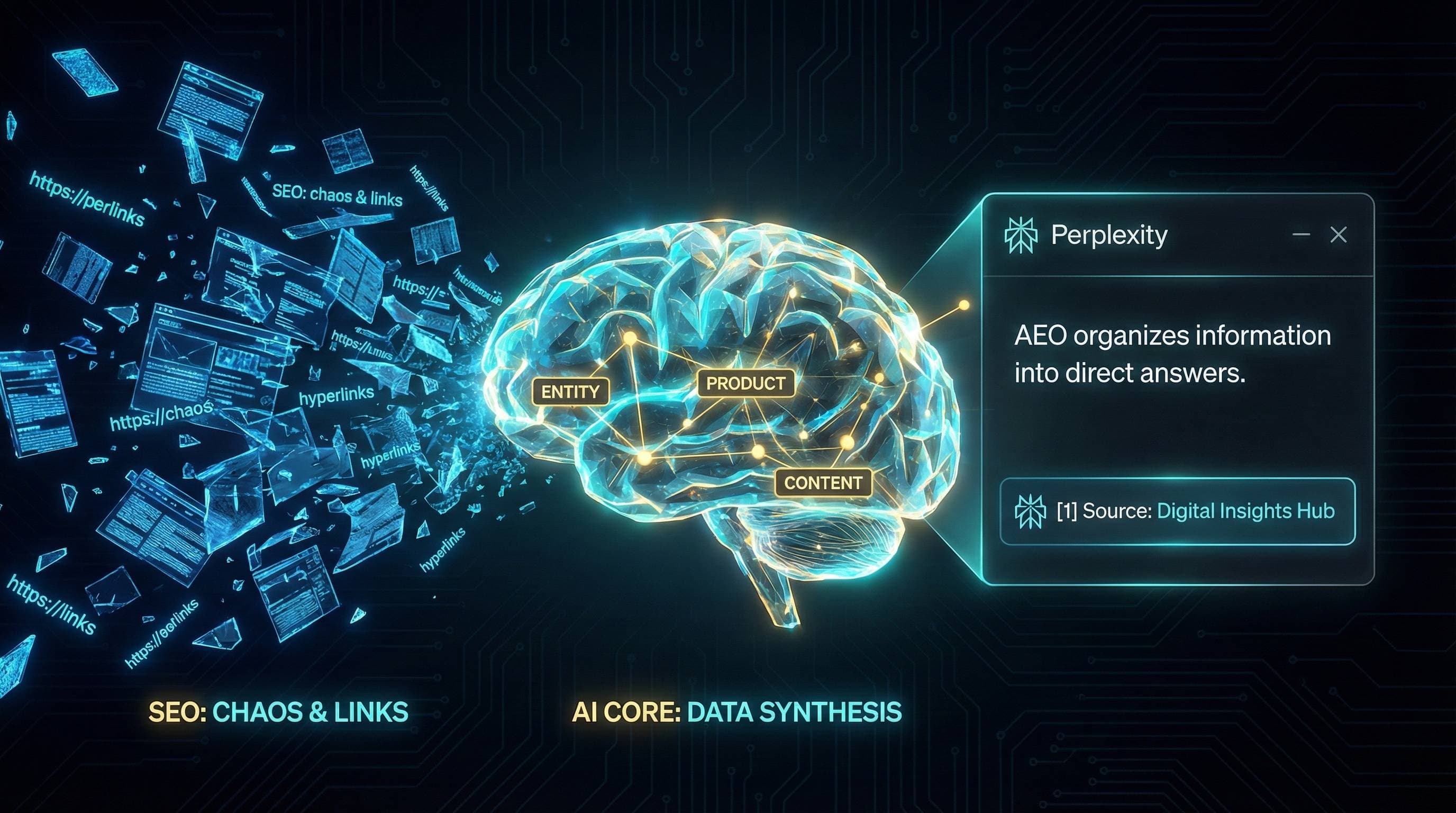
Now, your potential customers aren't clicking links. They're asking Perplexity, ChatGPT, or Gemini a question. And those engines aren't sending traffic to your blog; they're reading your blog, synthesizing the answer, and maybe citing you as a source.
This is the shift from SEO (Search Engine Optimization) to AEO (Answer Engine Optimization).
If you ignore this, you aren't just losing traffic. You're becoming invisible.
Here is the technical roadmap to making sure your SaaS gets cited, not ignored, in 2026.
The Death of "10 Blue Links": Why Google Search is No Longer Enough
For two decades, the "deal" between search engines and founders was simple. We gave them content; they gave us traffic.
That deal is broken.
We are witnessing a definitive migration away from the heuristic sorting of documents (ranking based on popularity) toward a generative model. In this new reality, the primary interface isn't a search bar returning URLs. It's a conversational agent synthesizing answers from a probabilistic analysis of the global knowledge graph.
Think about how you use the internet today. When you want to know "How to implement feature flags in Next.js," do you really want to open five different tabs, dodge three pop-ups, and scroll past a life story to find the code snippet?
No. You want the answer.
And so do your customers.
The value unit of the internet has changed. It used to be the "click," representing a human navigating to your property. Now, according to research on the MACO Framework, the value unit is the "citation." This represents the algorithm's validation of your brand's expertise. (We covered this shift in depth in our GEO for SaaS guide.)
In this environment, visibility is binary. Your SaaS is either part of the synthesized answer, or it effectively doesn't exist.
What is AEO? Defining the 2026 Generative Search Landscape
Generative Engine Optimization (GEO) or Answer Engine Optimization (AEO) isn't just "SEO with better keywords." It requires a fundamental re-architecting of your digital presence.
Traditional SEO optimized for routing logic. You wanted to convince Google's algorithm that your page was the best destination to route a user toward.
AEO optimizes for machine comprehension.
In 2026, your primary "user" is a bot—specifically, a crawler with strict computational budgets and a preference for high-density information. These bots (like PerplexityBot or OAI-SearchBot) ingest your content, decompose it, and reconstruct it.
Research on Generative Engine Optimization indicates that these platforms utilize Retrieval-Augmented Generation (RAG) architectures. They don't just index; they "read."
What is the MACO Framework for AEO?
The MACO Framework is a methodology for optimizing content for AI citation:
- M - Mechanism: Understanding how the AI retrieves data (Vector Search vs. Keyword Search).
- A - Authority: Establishing "Entity Identity" via Unified Graph Schema.
- C - Content: Writing for "Token Efficiency" and high information density.
- O - Optimization: Structuring data for direct citation (FAQs, Lists, Tables).
If your content is full of fluff, hard to parse, or buried behind client-side JavaScript, the bot skips it. You don't get the citation. And if you don't get the citation, you don't get the "Referral" traffic that comes from high-intent users clicking the footnotes in Perplexity.
The MACO Framework: How to Optimize for Brand Attribution in Perplexity Answers
So, how do you engineer your content to be the chosen source?
Forward-thinking organizations are adopting what researchers call the MACO Framework. This methodology breaks down optimization into three pillars: Attribution, Content Fidelity, and Semantic Dominance.
Let's focus on Attribution first. This is the art of getting credit.
For a Large Language Model (LLM) to cite you, it needs to easily extract the answer from your content. If the AI has to struggle to find the point, it will hallucinate or choose a competitor who wrote it more clearly.
You need to use "Direct-Answer" headers.
This leverages the "inverted pyramid" style of journalism but adapted for algorithmic readers. Here is the anatomy of a block that gets cited:
- The Trigger: A header (H2 or H3) formatted as a specific question.
- The Nose (The Answer): The text immediately following the header. The first sentence must be a direct, definitional answer.
- The Elaboration: Data tables or bullet points supporting the claim.
A Practical Example
Let's say you run a dev-tool SaaS.
Bad (Traditional Blog Style):
H2: Understanding Identity Management In today's complex security landscape, many developers struggle with how to handle logins. It's a journey that...
Good (AEO/MACO Style):
H2: What is headless identity management? Headless identity management is an API-first authentication architecture that decouples the backend identity provider (IdP) from the frontend user interface. This separation allows developers to implement custom login experiences...
See the difference? The second example gives the bot a perfect, bite-sized definition it can lift and cite. Research shows that alignment with this "Direct-Answer" structure minimizes retrieval friction for the AI agent, significantly increasing your "Citation Prominence."
Unified Graphs: Linking Your SaaS Entity to Your Insights via JSON-LD
You might write the best content in the world, but if the AI doesn't know who you are, it might not trust you enough to cite you.
Authority in the AI era isn't just about backlinks. It's about Entity Authority.
The AI needs to understand the relationship between your Brand, your Products, and your Content. We achieve this through Unified Graph Schemas.
Most SaaS sites have fragmented schema. You have "Organization" markup on your home page and "Article" markup on your blog, but the search engine sees them as isolated data points.
A Unified Graph uses specific identifiers (@id) to link these nodes together. You want to tell the bot: "The Organization that built this Product is the exact same entity that published this expert technical guide."
The "sameAs" Validation Loop
This is critical for new SaaS brands. You need to use the sameAs property in your schema to bridge your website with external sources of truth.
When Perplexity crawls your site, it looks for validation. By populating the sameAs array in your Organization schema with links to your Crunchbase, LinkedIn, and G2 profiles, you create a validation loop.
As noted in technical analyses of the MACO framework, this "triangulation" of identity promotes your brand from a mere website to a recognized "Entity" in the Knowledge Graph. It makes you a "hard node" in the model's reasoning, increasing the likelihood that you'll be cited across a spectrum of queries.
Practical Machine-Readability: Writing for Token Efficiency
Here is the harsh truth about AI crawlers: they are lazy. Or, more accurately, they are expensive to run, so they take shortcuts.
This leads to two massive technical hurdles for SaaS founders: Token Efficiency and The Rendering Crisis.
The Rendering Crisis (SSR is Non-Negotiable)
Modern SaaS marketing sites love React. We love our Single Page Applications (SPAs) and fancy client-side transitions.
But here's the problem. Independent analysis confirms that bots like PerplexityBot and GPTBot generally do not render JavaScript. They retrieve the raw HTML response.
If your content relies on Client-Side Rendering (CSR), the bot sees an empty <div>. It sees nothing.
Content Fidelity requires that the raw HTML payload contains the complete semantic representation of the page. If you are building on Next.js, you must use Server-Side Rendering (SSR). If you are on a legacy stack, you need a dynamic rendering solution to serve static HTML to bots.
The "Fluff" Penalty
Even if the bot can read your content, will it "pay" to process it?
LLMs operate on tokens. Processing tokens costs money (inference cost) and takes up space in the context window.
OpenAI's retrieval cost models effectively penalize low-information tokens. If you write a 2,000-word blog post that contains only three unique insights, the RAG system will likely discard it in favor of a 500-word summary that contains the same data.
We call this Token Efficiency.
Your goal is to maximize the "Information Density Score."
- "Our platform leverages the infinite power of cloud computing to streamline operations." (30 tokens, 0 facts)
+ "Enterprise cloud computing reduces operational latency by 40% through edge caching." (12 tokens, 1 fact)
Why This Matters for Founders
I know what you're thinking. "I'm trying to build a product. Now I have to engineer my blog post structure, debug JSON-LD schema, and worry about server-side rendering?"
It feels like a lot.
But this is the new reality of digital distribution. The brands that win in 2026 won't necessarily be the ones with the biggest ad budgets. They will be the ones that make it easiest for the machines to understand, trust, and cite them. This isn't just a hack; it's the technical foundation of your 90-Day Organic Traffic Roadmap.
You don't have to overhaul everything overnight. Start by looking at your top 5 performing blog posts. Do they answer questions directly in the first paragraph? Are they full of fluff? (Not sure where to start? Here's how to write SEO blog posts without spending 10 hours.)
Fix those. Then move to the schema.
The shift to AEO is an opportunity. Most of your competitors are still stuffing keywords into meta tags like it's 2015. If you start optimizing for citations now, you'll own the answers before they even realize the question changed.
This is exactly why we built ShipContent. We don't just write blog posts—we engineer them for AI citation. If you want your SaaS to show up in Perplexity answers instead of disappearing into the void, let's talk.