Key Takeaways
- Your docs are the landing page now. Developers evaluate products by reading documentation first. If it's messy, they assume your code is too.
- 60% of Google searches are "Zero-Click." AI Overviews extract your code snippets and display them directly—users never visit your site.
- Search intent mismatch kills conversions. Developers searching "how to build X" want tutorials, not API reference pages.
- Use the Diátaxis framework. Split content into Tutorials, How-To Guides, Reference, and Explanation based on user intent.
- Minimize Time to First Hello World (TTFHW). Interactive playgrounds can increase trial-to-paid conversion by up to 40%.
You've probably seen the weird anomaly in your Search Console. Your documentation is ranking at position 2.0 for a high-intent technical query—something like "how to build a marketplace" or "Python API timestamp conversion." The impressions are through the roof. But the clicks? They're non-existent.
It's a gut punch. You've spent weeks perfecting your code and documenting every endpoint. Yet, for some reason, the developers you're trying to reach just aren't clicking through to your site. Or if they do, they bounce faster than a failed build.
The reality of developer marketing has shifted. We're moving away from a world where documentation was just a "user manual" handed over after a sale. Today, your docs are the landing page. They're the sales engineer. They are the technical proof-of-concept for every skeptical founder who lands on your site.
If your /docs folder is just a graveyard of dry reference material, you're leaving money on the table.
The Documentation Trap: High Impressions, Low Conversion for /docs
The "blue link" economy—the one we've all relied on for a decade—is being eroded. It's happening right in front of us. According to research on developer acquisition engines, approximately 60% of Google searches now result in "Zero-Clicks". This means the user's intent is being satisfied directly on the search page.
Google's AI extracts your code snippet, displays it in an AI Overview, and the developer gets what they need without ever visiting your site. The traffic is gone. And with it, your chance to turn that visitor into a signup. (This is the same CTR Gap that's killing organic roadmaps everywhere.)
But there's a deeper problem. Even when developers do see your link, they might not click. Why? Because they're in a state of high cognitive load. They have a specific, blocking problem, and they're looking for a solution, not a feature list. If your search result looks like a dry "v2.1 API Reference," they'll skip it in favor of a guide that promises a "5-minute integration."
Trust is the only currency developers care about. If your documentation is fragmented or sounds like marketing fluff, they'll assume your product code is just as messy. For a technical founder, the "User Experience" of your docs is the "User Experience" of your product.
The "How to Build" Query: Capturing the High-Intent Technical Founder
There is a massive gap in how most SaaS companies handle search intent. When a founder searches for "how to build a marketplace," they are looking for a narrative. They want a step-by-step architecture.
However, many developer portals rely on their API Reference pages to rank for these keywords. This is a fundamental mismatch. Reference docs are dictionary-like—they are feature-centric. But the user's intent is problem-centric.
If a developer searches for a solution and hits a wall of endpoints, they'll leave. They aren't ready to see the code for a specific POST request yet. They want to understand the sequence of operations.
To win these queries, you have to create "Solution-Led" content. These are intermediary layers—Tutorials and How-to Guides—that serve as a "Hub." They provide the context and then link out to the "Spoke" reference pages for the nitty-gritty details.
You've got to use power words that appeal to developer values in your titles. Words like:
- Quickstart
- SDK
- Example Code
- JSON
- Webhooks
These terms signal that the page contains actionable technical assets. Not just more marketing talk.
Bridging the Gap: How to Link Your API Capabilities to Business Solutions
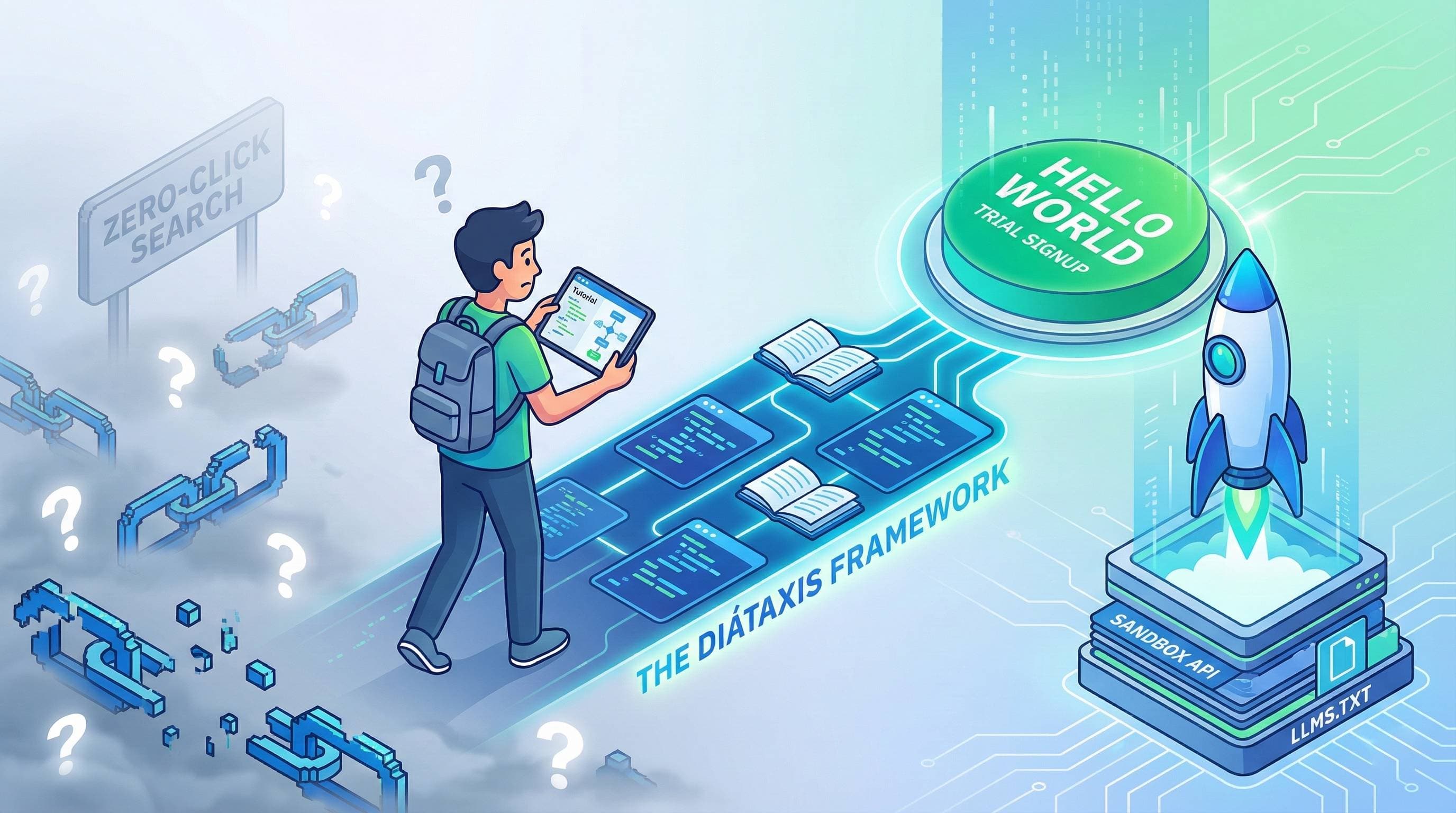
We need a better way to organize technical content. The industry standard that's gaining steam is the Diátaxis framework. It splits documentation into four quadrants based on what the user needs at that exact moment.
The Four Quadrants of Content
| Category | Type | User Need | Goal |
|---|---|---|---|
| Tutorials | Learning-oriented | "I want to learn." | Acquisition of a new skill. |
| How-To Guides | Task-oriented | "I want to do." | Solving a specific problem. |
| Reference | Information-oriented | "I need to know." | Describing the machinery. |
| Explanation | Understanding-oriented | "I want to understand." | Background and architecture. |
The biggest mistake? Burying your best solution-led content in a marketing blog. Developers often block marketing sites or just plain distrust them.
The fix is simple. Migrate those "Solution-Led" posts into your documentation structure.
Create a "Hub" guide—like "Building a Secure Checkout"—that explains the business logic. Then, link to your "Spoke" reference pages for the actual API endpoints. It creates a bridge. A developer looking for a specific endpoint discovers a full solution guide, which makes them way more likely to actually sign up.
AEO for Documentation: Making Your Technical Specs Machine-Readable for AI Agents
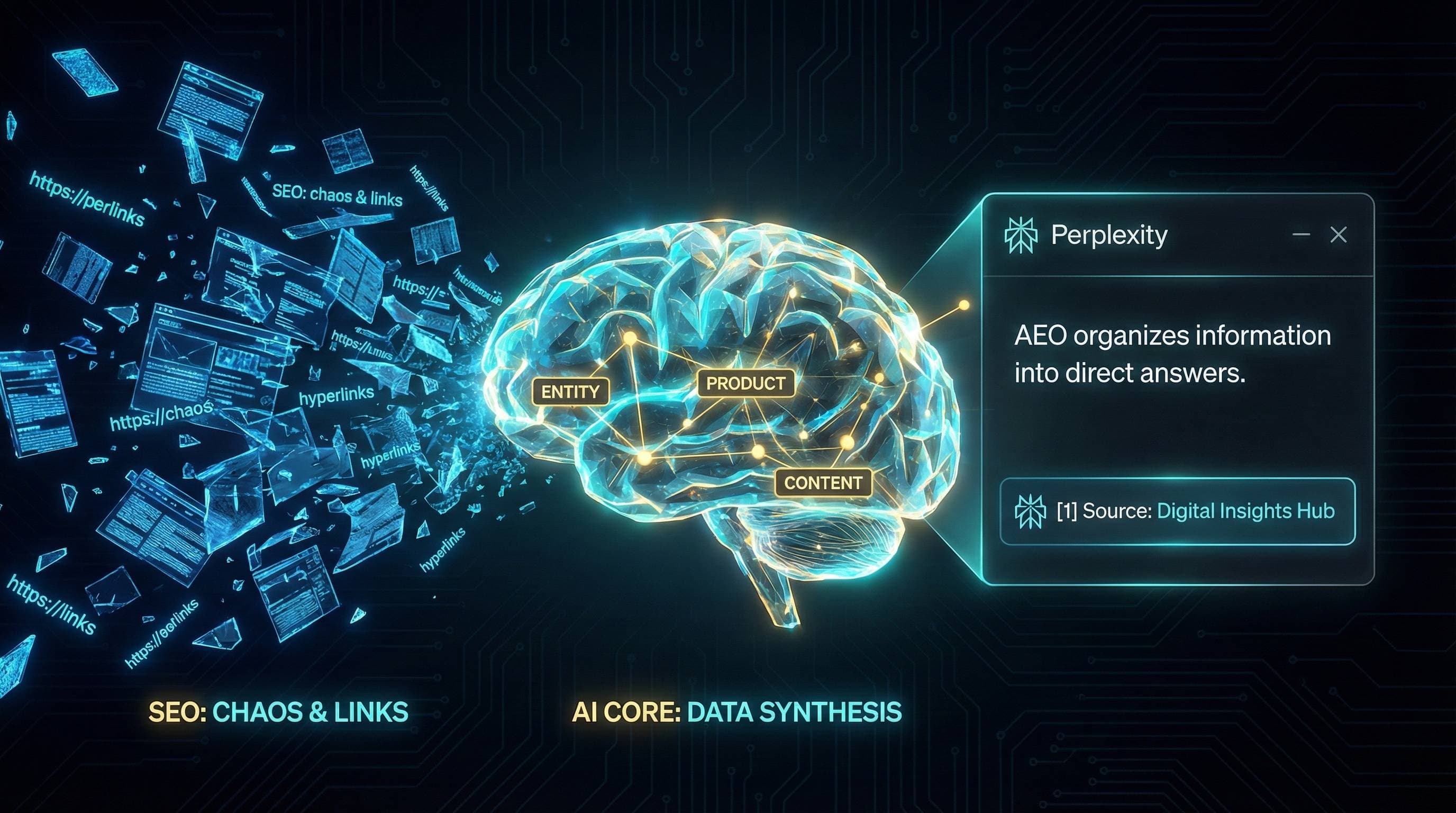
The way docs are consumed has changed forever. In 2026, the "user" reading your documentation is often an AI agent. Maybe it's a coding assistant like GitHub Copilot or an answer engine like Perplexity.
If your docs aren't optimized for "Machine Readability," these AI tools will hallucinate. They'll give users outdated code or fail to cite your brand entirely. This is why Generative Engine Optimization (GEO) is becoming a core part of technical SEO.
Industry research shows that while 84% of developers use AI tools, nearly half don't trust the output accuracy. This "Trust Gap" is your opportunity. If your docs are the most semantically clear source of truth, AI tools will prioritize your official solution over a random Stack Overflow thread from 2019.
The llms.txt Standard
A new standard called llms.txt is emerging to help AI agents. It's like a robots.txt for the AI age. You place it in your root directory and point it to a simplified, Markdown-only version of your docs. This allows an LLM to ingest your entire platform architecture in one pass without getting lost in your JavaScript-heavy navigation menus.
Semantic Heading Hierarchy
AI models rely heavily on your H1, H2, and H3 tags to build a mental map of your content. Don't jump from an H1 to an H4—it confuses the model's understanding of parent-child relationships.
And make your headers descriptive. Instead of just saying "Setup," use "Setting up the Node.js Client." It explicitly links the content to the entity for the model.
Conversion Strategy: Moving a User from "API Explorer" to "Trial Signup"
Once you finally get a developer to your page, the goal shifts to conversion. In developer marketing, "Conversion" is an activation event. It's usually the first successful API call—what we call the Time to First Hello World (TTFHW).
The Power of Playgrounds
Static code snippets are high-friction. The developer has to copy the code, open their IDE, install your SDK, find their keys, and then run it. That's five chances for them to get distracted and quit.
Interactive Playgrounds remove that friction. They embed a live environment right in the browser. Research indicates that these interactive environments can accelerate onboarding by 30-50% and increase trial-to-paid conversion rates by 40%.
Lazy Registration
Don't force a developer to create an account before they see the API work. It's a huge trust barrier. Try the "Lazy Registration" pattern instead:
- Let them use a playground with a temporary sandbox key.
- Let them see the JSON response.
- Only after that success moment, show them a CTA to "Sign up to save this configuration".
This uses the "Endowed Progress Effect." They've already started the work—signing up is just saving their progress.
Personalized Context
Look at Stripe. They are the gold standard for a reason. When you're logged in, their code snippets are pre-filled with your actual API keys. No placeholder text. No manual copying. It makes the transition from "reading" to "doing" feel natural.
Measuring What Actually Matters
Traditional marketing metrics like pageviews or bounce rates are often useless for technical docs. A developer might land on a page, find the error code they need in 10 seconds, and leave. Google Analytics calls that a "Bounce." I call it a "Success."
We have to look at different signals. Research suggests focusing on AARRR metrics adapted for devs:
- Activation: Time to First Hello World (TTFHW) and playground executions.
- Retention: Weekly Active Tokens (WAT) and frequency of reference visits.
- Acquisition: AI citations and share of answer in search engines.
Even DORA metrics—usually for engineering teams—can be marketing signals. If you can reduce the time from "Signup" to "First Production Deploy," you're proving the value of your documentation.
Your Docs Are Your Infrastructure
The shift is clear—whether we like it or not. Documentation is no longer a cost center. It is your most efficient engine for acquiring technical customers.
In the "Zero-Click" era, you have to serve two masters. You need semantic structure for the AI agent and interactive, solution-led narratives for the human developer. The "Low CTR" you're seeing for technical queries isn't a failure of your product. It's a signal that your content architecture needs an upgrade. (Need a system that understands your code? Here's why Product-Aware AI beats generic writing tools.)
By treating your docs as a product—with its own UX, testing, and personalization—you turn a dry manual into a conversion machine.
This is exactly what ShipContent helps with. We don't just write marketing fluff—we create technical content that developers actually trust. Product-aware, SEO-optimized, and built to convert. See how it works.