Key Takeaways
- The CTR Gap is killing your roadmap. High impressions + flat clicks = you're ranking in positions 50-80, not 1-3. Google is testing you, not trusting you.
- "Ghost Impressions" are a trap. Vertical visibility (many low-ranking terms) doesn't equal Horizontal dominance (top 3 for high-intent keywords).
- Velocity beats perfection. SaaS blogs publishing 9+ posts/month see 41.5% YoY traffic growth vs. 21.3% for 1-4 posts/month.
- Your meta-descriptions are boring. Switch from feature lists to PAS (Problem-Agitation-Solution) copy to trigger emotional clicks.
- Target "Striking Distance" keywords. Pages ranking 11-20 are your low-hanging fruit—refresh content and add internal links to push them to Page 1.
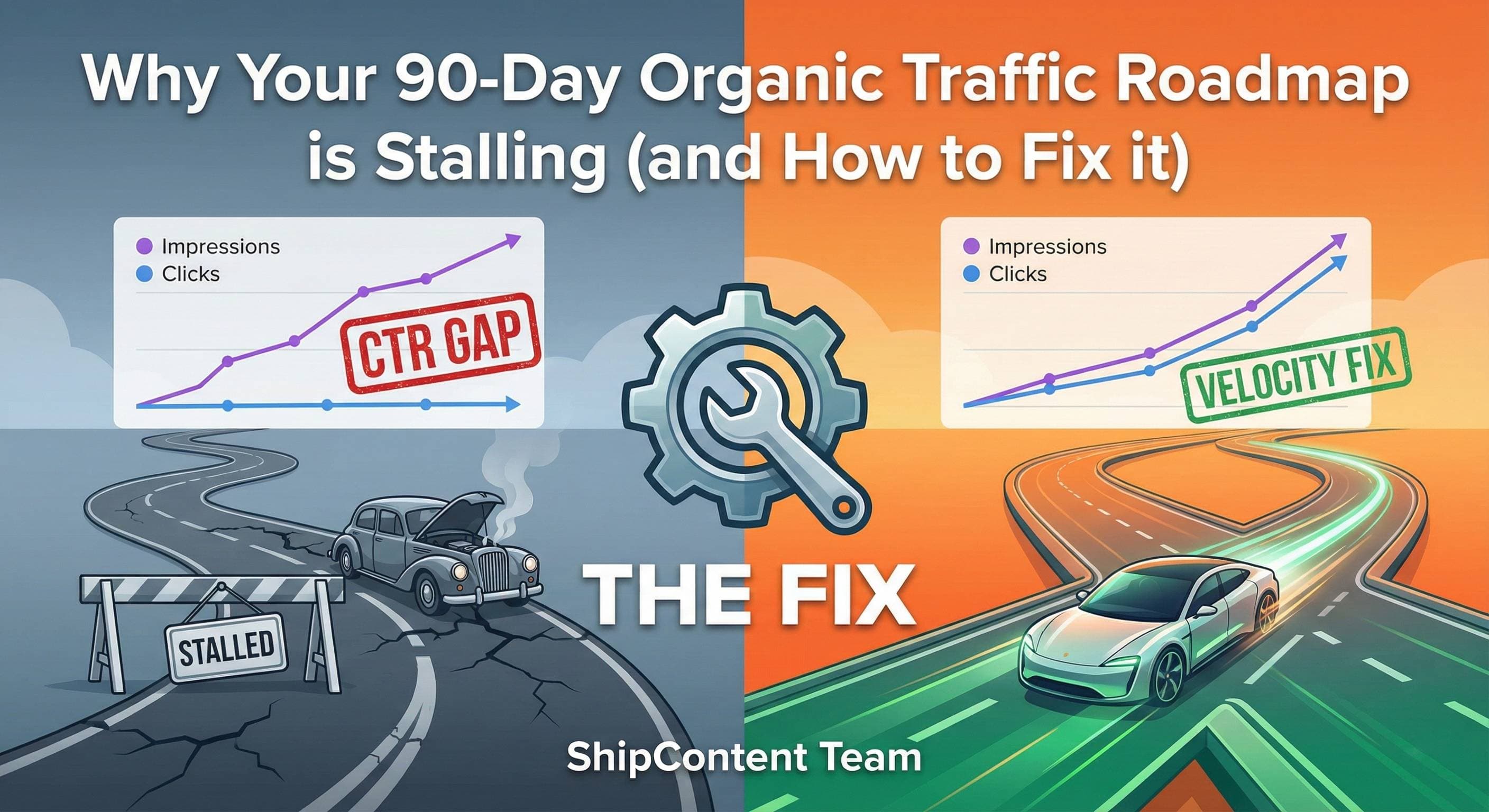
You've probably seen the graph. It's the one every founder stares at in Google Search Console (GSC) around month three. The purple line—Impressions—is climbing. It looks like a hockey stick. It looks like success.
But the blue line? The Clicks?
Flat. Dead flat.
It's frustrating. You're "ranking," technically. But nobody is visiting. This specific type of misery is what we call the CTR Gap. It's where most 90-day organic roadmaps go to die. The problem isn't usually your content quality (though it might be). The problem is that you're misinterpreting what Google is trying to tell you.
The algorithm is testing you. And right now, you might be failing the test.
The Impression Paradox: Why Visibility is Vertical but Clicks are Horizontal
Here is the hard truth about new domains: Google doesn't trust you yet. Not really.
When you launch a new site, or even a new cluster of content, the algorithm engages in "Vertical Impression Growth." Your site is tested against thousands of broad queries to see where it fits. You might show up in an Image Pack for "SaaS dashboard" or trigger a snippet for a synonym of your main keyword.
These count as impressions. But they are "Ghost Impressions."
You are ranking in position 50, or position 80. Or you're appearing in an image carousel that users scroll past looking for an answer. Your visibility is growing vertically—deep into the index for many terms—but your clicks are stagnant because you haven't achieved "Horizontal" dominance (ranking in the top 3 for specific, high-intent terms).
It's a common trap. According to data discussed in search industry forums, high impression counts with near-zero clicks often indicate that a site is ranking for visual elements or broad queries where the user intent is purely informational, not transactional. And with AI search engines now citing sources directly, traditional rankings matter even less if you're not in the top positions.
You feel like you're growing. But you're just being browsed.
Troubleshooting Month 1: The "Foundation Phase" Traps Solo Founders Fall Into
In the first 30 days, most founders obsessed over the wrong things. They tweak the logo. They argue about the shade of blue on the submit button. They install seven different analytics plugins.
Meanwhile, the technical foundation of the site is crumbling.
A roadmap is useless if the road has potholes. One of the most common reasons traffic stalls early on is that Google's crawlers are hitting walls before they even get to your content. We're talking about basic technical hygiene: broken links, missing H1 tags, and slow load times.
It doesn't have to be perfect. But it has to be clean.
Take the case of the AI tool Omnius. Before they scaled content, they didn't just write; they fixed the "leaky bucket." Their strategy involved resolving 404 errors and fixing duplicate tags first. This ensured that every bit of "crawler credit" Google spent on them resulted in a valid indexable page.
If you skip this, you're just pouring water into a sieve.
The Velocity Gap: Why 2 Posts/Month Isn't Triggering the Traffic Spike
There is a myth that "quality over quantity" is the only rule in SEO.
It's a half-truth. Quality matters, yes. But in the early stages, quantity is a quality of its own. If your roadmap includes publishing one "ultimate guide" every two weeks, you are moving too slow to break the algorithmic inertia.
You need velocity.
New domains need to signal Topical Authority. You can't do that with three articles. You do that by covering a topic so thoroughly that Google has no choice but to see you as an expert. This requires "Content Clusters"—a pillar page supported by dozens of related articles.
Look at Monday.com. Their pre-IPO strategy wasn't about posting occasionally; they scaled to publishing over 100 articles a month. They swarmed topics. They built a moat of content so deep that competitors couldn't cross it.
If you are publishing sporadically, you aren't building a library. You're just leaving flyers in the wind—a pattern we've seen kill 37% of SaaS blogs. You need to tighten the cluster and up the tempo.
Strategic Fix: Optimizing "Impulse B2B" Meta-Descriptions for CTR
Okay, so you have impressions. You have content. Why aren't they clicking?
Because your meta-descriptions are boring.
Most B2B SaaS descriptions read like a spec sheet. "Our software features API integration, SSO, and real-time analytics. Sign up for a trial."
This appeals to the logical brain (System 2 thinking). But humans—even B2B buyers—make snap decisions with their emotional brain (System 1 thinking). When scanning a search result page, they aren't looking for features. They are looking for relief from pain.
You need to switch to "Impulse B2B" copy. This often means using the Problem-Agitation-Solution (PAS) framework.
- Problem: Call out the struggle.
- Agitation: Twist the knife (gently).
- Solution: Offer the way out.
Instead of listing features, try this: "Drowning in manual spreadsheets? (Problem) Errors are costing you hours and credibility every week. (Agitation) Automate your reporting in one click with our verified templates. (Solution)"
The difference is massive. In fact, experiments have shown that video ads using the PAS structure can outperform feature-focused creative by 2.5x in generating qualified leads. The same psychology applies to the text snippet on Google. You have 160 characters to trigger an emotion. Don't waste them on a feature list. (Need help with the actual writing? Here's how to write SEO blog posts without spending 10 hours.)
Action Plan: Moving from Foundation to Velocity in the Next 30 Days
So, how do you fix the stall? You stop waiting and start pushing.
First, identify your "Striking Distance" keywords. These are the terms where you are currently ranking on Page 2 (positions 11–20). You are close. Google likes you, but it doesn't love you yet.
Industry insights suggest that moving a keyword from the second page to the first page can result in a massive traffic multiplier, given that over 90% of clicks happen on Page 1.
Here is your 30-day sprint:
- Audit GSC: Find those high-impression, low-click keywords.
- The "Push" Update: Go to those specific pages. Rewrite the meta-description using PAS. Add a "Key Takeaways" section at the top. Embed a video if you have one.
- Cluster Up: Don't just write random posts. Pick your best performing topic and write 5 supporting articles that link back to it. (Can't scale content alone? Compare your options.)
- Check Tech: Run a crawl. Fix the 404s.
Your roadmap isn't stalled because the market is dead. It's stalled because you're treating SEO like a waiting game. It's not. It's a race.
Shift gears.
This is exactly why we built ShipContent. If you're tired of staring at flat click graphs while your impressions mock you, let's fix that together.